Bridging Theory and Practice
for Actionable Change in Transforming Food Systems
The BRIDGE-ACT Toolkit
This research was funded through the Transforming the UK Food System for Healthy People and a Healthy Environment SPF Programme, delivered by UKRI, in partnership with the Global Food Security Programme, BBSRC, ESRC, MRC, NERC, Defra, DHSC, OHID, Innovate UK and FSA.
Transforming the UK's food system requires researchers, policymakers, businesses, and communities to work together. However, making meaningful change can be challenging, as food systems research spans many disciplines and involves complex interactions between different stakeholders.
The BRIDGE-ACT project aimed to bridge the gap between research and real-world impact with this interactive, user-friendly toolkit that helps food systems researchers and decision-makers plan effective impact delivery strategies.
Watch the toolkit in action
This video presents the testing phase of the Bridge-ACT toolkit during the workshop organised in collaboration with NIHR: Health Determinants Research Collaboration (HDRC) Aberdeen. It showcases how participants engage in systems thinking to explore complex food system challenges, moving beyond surface-level issues to identify underlying drivers and structures.
Built on the flower diagram
The toolkit builds on the widely recognised "flower diagram" by Parsons, Hawkes and Wells (2019), which illustrates the interconnected nature of the food system. The diagram places the food supply chain at its core, surrounded by five key dimensions to highlight their interrelations.
While the flower diagram is effective for high-level theoretical discussions and policy planning, the BRIDGE-ACT toolkit was designed to enhance practical, place-based understanding by representing food system concepts in a geographical-style format. This approach translates abstract ideas into tangible elements such as farms, factories, or communities, fostering systems thinking and encouraging the inclusion of collaborators who may lack expertise in food systems dynamics.
Parsons, K., Hawkes, C. & Wells, R. (2019). Brief 2: Understanding the food system: Why it matters for food policy.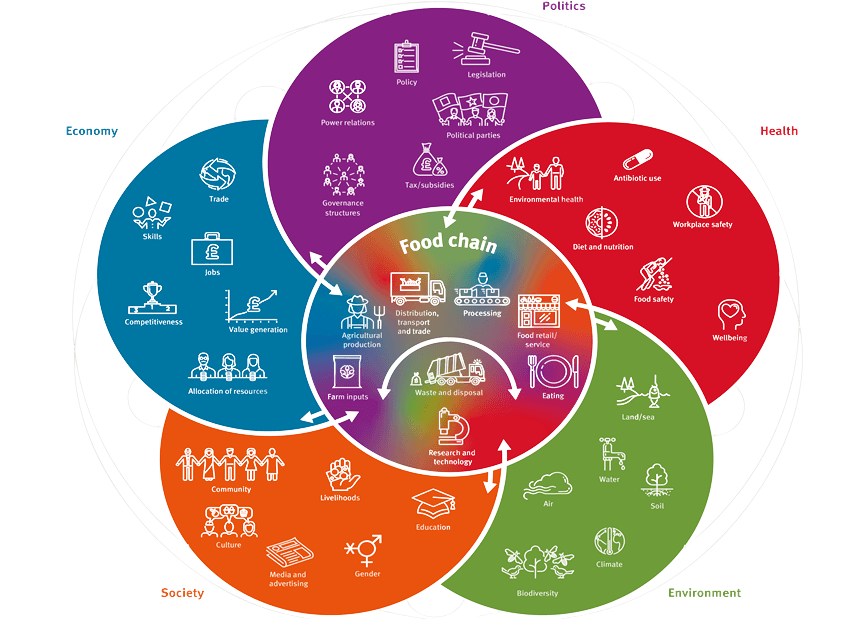
Using mapping and visualisation techniques
The toolkit enables users to explore how different parts of the food system connect, identify key areas for intervention, and develop strategies to create positive change.
Systems Visualisation
Mapping techniques are widely used in systems thinking to visualise complex relationships (e.g., causal loop mapping, food chain maps, and neighbourhood food maps) (Edwards & Mercer, 2010).
Participatory Mapping
Advances in deep mapping and counter-cartography, supported by new technologies, have enabled more participatory and collaborative mapping approaches.
Cognitive Engagement
Research shows that interactive, context-based visualisation improves cognitive engagement and learning retention (Domagk et al., 2010).
Strategic Decision-Making
Real-world maps simplify complexity, enhance stakeholder engagement, and support strategic decision-making by simulating interventions and exploring trade-offs (Reed et al., 2025).
Select an audience to learn more
Ready to explore the toolkit?
Start with the interactive food system map, or jump straight into the Prepare stage.